Dragon of mishbil v1 0, p.1
Dragon of Mishbil (v1.0), page 1


Author’s Note
Mishbil’s fictional difficulties have an exact counterpart on our globe. The pre-Hispanic Chimu Indians of northwest Peru excavated a complex canal system about 700 years ago that extended 50 miles to link two separate drainage basins. Movements of the earth’s crust gradually thwarted their astonishing hydraulic engineering and, after years of painful redigging, the system’s deathblow was finally delivered by torrential rains around 1300 A.D.
That phenomenon is known nowadays as El Nino. Tornados in California, brush fires in Australia, drought in Indonesia, devastating downpours in Ecuador and coastal Peru—all can be credited to a rare warming of surface waters in the eastern equatorial Pacific.
This book was written in a particularly bad El Nino year. As much as 300 percent more rainfall devastated some countries; a headline in the Washington Post reads, “Five Months of Torrents Swamp Peruvian Desert.” The author is certain this timing is a coincidence.
—B.W.C.
B.W. CLOUGH has also written:
THE CRYSTAL CROWN
THE DRAGON
OF MISHBIL
B.W. CLOUGH
Copyright ©, 1985, by B.W. Clough.
All Rights Reserved.
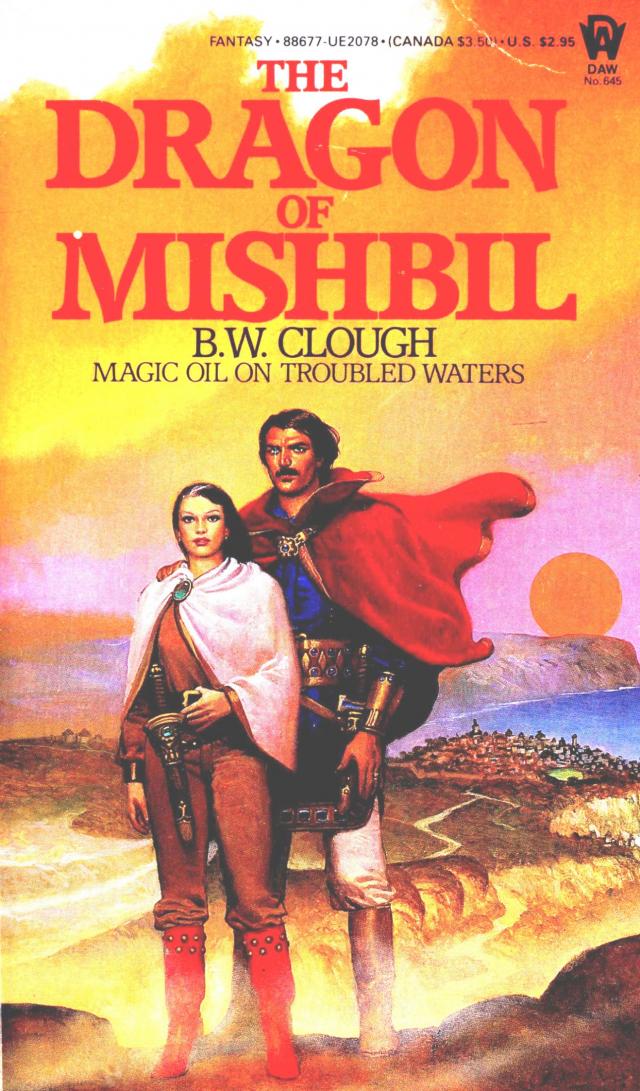
Cover art by Segrelles.
DAW Collectors’ Book No. 645
DEDICATION
To Larry, my most fervent fan.
First Printing, September 1985
1 2 3 4 5 6 7 8 9
Printed in U.S.A.
MISHBIL - THE TOWN AND MAJOR CANALS
No man, I suppose, is tempted to every sin. It so happens that the impulse which makes men gamble has been left out of my make-up; and, no doubt, I pay for this by lacking some good impulse of which it is the excess or perversion.
C. S. Lewis
Chapter 1: Mid Summer Day
The rule for wishes at the Temple of the Sun is that the petition must be made by the concerned party only. Farmers approach the deity one by one to wish for good harvesting weather, though the warmth that ripens the grain would shine equally on all. And though a pregnant woman may thank the goddess Ennelith for her fertility, if she wishes a babe of one sex or the other she must carefully climb the winding road—it is steep, up the scarp to the Upper City—to make the wish, and neither husband nor parent may make the request in her place.
Therefore, when Zaryas.-yu Borletsikan, ruling princess of Mishbil, presented her offering and wish Mid Summer Day she knew the voyage north might well be in vain. “Yet what could I have done?” she demanded of the priestess. “Brought the entire population of my city along to wish?”
“You are their mediator before the god,” the holy woman replied. “And it is a very propitious day. Let us make the offering and see.!’
No blood may be shed at the altar of the Lord of Life, so Zaryas had brought eight red porcelain jars of aromatic gums and spices. Her retinue waited behind while she and the priestess approached the central altar. Only Zaryas’ firm booted step echoed back from the towering golden dome above the circular sanctuary, for the priestess wore soft leather slippers. As they came near, the presence of the deity seemed to press on her soul silent and heavy and full of light, like massive gold. She tried to tread more quietly, with partial success.
In awed silence she watched the perfumes, worth far more than silver, poured out onto the altar. Sweet blue smoke billowed up in heady clouds, making her sneeze, but the priestess’ steady gaze did not waver from the flames. Fueled by the oily essences the fire leaped, roaring high above their heads, shooting out a fountain of gold sparks and illuminating the great sanctuary like a lightning bolt. Zaryas retreated a pace or two and wiped her streaming eyes with a silk handkerchief.
Without turning her head the priestess said, “Repeat your wish,-please.”
“That the canals of Mishbil conduct water again,” Zaryas said in a thick voice.
For a long moment the crackle of flame was the only reply. Then the priestess turned away and Zaryas saw the doubt in her face. “The omens are clouded, princess,” she told Zaryas. “Your wish shall be granted, but not as you expect.”
“That, alas, will not do.” Zaryas coughed and rubbed her burning eyes with thumb and forefinger. “Should I have wished simply for the canals and rivers to flow as they used to?”
“To answer that I need not consult the Sun,” the priestess said. “Times, like rivers, never turn back. You and your city must go forward.”
“When the wind fails, unship your oars,” Zaryas quoted the proverb to her aides. So her next call was at the Palace of the Shan King. In contrast to the archaic severity of the Temple beside it,, the Palace was a rambling complex of interconnected halls and chambers. Every possible style of building was manifested in exuberant glory, unified only by the purity of polished white marble and the favorite triple-arched windows. Every year at winter solstice Zaryas journeyed here to present her King with an account of the year’s doings. But she had never deigned to master the intricacies of the Palace maze. “Your own fault,” she often told King Varim. “Appointing an absent-. minded little snip to run Mishbil for you!” The incongruity of this always made the King laugh, for both knew Zaryas never forgot or forgave anything.
The Shan King’s schedule that day was full. In an excess of nepotism a minister had staffed his department entirely with relatives, and the King had to decide how many of them to execute. But by pleading emergency Zaryas was allotted a few moments between appointments. The monarch heard his viceroy’s tale with interest. The Crystal Crown gleamed so white and luminous on his brow that all the life in the pale old face seemed to be draining upward. Varim looked far more worn than he had six short months ago. But, mindful of time constraints, Zaryas kept to her story.
“I personally cannot help you,” the King told her when she had done. “My feeble powers are only over man.”
“Then give me magi, Your Majesty,” Zaryas said. “Strong hydromants to command the waters to flow rightly, or pirolurges to scorch the channels open again. My own water-wizards have thrown up their hands in despair!”
“Truly? Then you must be desperate indeed,” the Shan King sighed. For Mishbil is noted for its hydromants. “The Chamberlain will conduct you to the Master Magus right away. Zarlim has promoted some, notable magi recently out of the apprentice ranks. Have him invite you to dine. The magi’s cook makes up in succulence what their table lacks in substance.”
The shift to homelier topics allowed Zaryas to demand, “And what of you, Varim, have you been eating properly?”
The old King sighed again. “Kings are not long-lived in Averidan,” he said.
“Nonsense!” Zaryas said robustly. “You’ve long, lecherous years in you yet. Why, if it weren’t for your wife I’d take you on myself.”
‘
Once, Varim would have laughed aloud at that. Now he chuckled. “Executing people tires me, that’s all,” he declared. “You mustn’t tempt an absolute despot, dear Zaryas. I might give way and include the Lady in this latest batch of lapidations. Now run along with you, I have more unpleasant business.”
The most high-ranking Chamberlain conducted Zaryas and her party to the magi. Down dozens of wide solemn corridors they went, twisting and turning, up stairs and down, until they lost their bearings entirely. Zaryas, an inveterate gambler herself, grumbled that they were being led by circuitous routes on a wager. But at last they were shown into an open courtyard enclosed by colonnades of gray marble. On benches set near the circular scrying pool sat several men in long robes of dark red linen, with matching peaked and lappetted caps on their heads. They rose to greet Zaryas, laying aside their writing tablets.
“Zarlim, Master Magus,” she greeted the eldest, remembering him from other occasions.
“Zaryas-yu, princess of Mishbil,” the stout old magus returned. “These are my assistants, Xerlanthor and Xantallon.” To either side the younger magi bowed to her. “Sit, and tell us your business.”
Zaryas came forward to take the offered bench, and gasped in horror. Level with the pavement, lined with pure black marble, and brimful with limpid water, the pool seemed to be an endless shaft, piercing the uttermost depths of the earth. The sudden vertigo was so terrible she felt her head spin. But seeing her distress the Magus thrust the handle of his wide fan into the water, and the concentric ripples revealed the pool was only ankle-deep.
Furious at this demonstration of weakness Zaryas demanded, “Is it enchanted?”
“Not at all,” the Magus said. “The days when such pools were used for scrying are past.” “Mirrors are easier to carry around,” Xantallon explained kindly. He was a prodigiously tall and lean young man w’hom Zaryas had not met before, though from his narrow hawk-face she judged he was a native of Mishbil. He affected a limp black mustache which veiled his mouth, not being long enough to sweep to either side yet. Zaryas did not want anyone’s sympathy, and inwardly seething sat down on the offered seat to begin her tale for the second time that day:
“You know, of course, of the difficulties we’ve been having with the Bilcad River. Our sorrow, the Dragon of Mishbil—but our only source of water in the desert south. Thousands of canals conduct the river water to the fields, and so we live.”
“Generations of magi helped plan and dig those canals,” the Magus reminded her.
Taking the hint Zaryas hastened to her point. “For decades there has been less and less water in the river,” she continued. “We’ve dug and redug the canals year by year. This spring the ultimate di saster befell us. The Bilcad’s waters no longer reach the canal mouths. Our canals are dry, our fields dust, our crops sere.”
Xantallon rubbed long dry hands together. “I’d wager my staff,” he said, “that it’s not less water, but a deeper channel the river has cut for itself. Do you realize what that might prove?”
“You mean the theory that the entire seacoast of Averidan is rising?” Xerlanthor asked. “It’s still nothing but speculation, riddled with inconsistencies. For example, why doesn’t our shoreline here to the north rise also?”
“Several factors could account for that,” Xantallon argued. “What if sand is lighter than earth? What if earth currents behave as ocean currents do, swerving in toward the shoreline at one point only? Like this—” Taking the waxen tablet up he began to sketch, his mustache quivering with scholarly excitement, while Xerlanthor watched over his shoulder.
Snatching at her scattered wits Zaryas brought her hand down in a resounding blow on the bench beside her. “Do you mean to say you magi knew this would happen?” she demanded. “Why did no one inform me? Mishbil may starve next winter!”
The younger magi started, but their Master blinked at Zaryas with mild eyes. “This theory has been current in magian circles for twelve hundred years,” he said. “It was propounded by geomants to account for certain curious fluxes in the earth currents. Even if it’s correct the land rises very slowly—at most, a handspan every generation or so. The dangers are cumulative, of course, but it was hardly an urgent peril.”
“I suppose not,” Zaryas conceded. She frowned at the smiling pool of water before her. “The unfairness of it,” she sighed. “A trouble so many eons in the brewing, descending in my time.” Xerlanthor glanced up and smiled at her, a charming smile that warmed and heartened like a sip of plum brandy. “Are you less able to deal with it than your predecessors?” he asked.
“Of course not!” She looked more closely at him. This young magus was of a different breed entirely than his fellows, solid, rosy, and ever so slightly plump, like a ripening plum. Under the red cap a round, merry face smiled, the countenance of one who has always had fortune’s favor. She judged he was just past thirty—the age the demigod Shan Vir-yan had been when he founded Averidan. Magi are dreamers, but Xerlanthor’s intelligent dark eyes saw practicality, noted everything about her from the braided black hair flecked prematurely with gray to her plain yet vivid countenance, right down to her sensible red hobnailed traveling boots. Here, it seemed, was a courage and will that matched her own. “I like your spirit,” she declared. “A few more like you and we’ll deal with it indeed.”
Chapter 2: 2 Arbas
By tradition all viceroys in Averidan are appointed by the Shan King, who is ineluctably bound to choose the wise and competent. Varim had selected Zaryas four years ago. “No one at twenty-five years of age has any wisdom,” she had pointed out. “Why choose me?”
He had stared into her eyes so piercingly she was reminded of the uncomfortable proverb, that the Shan King reads hearts. “My dear princess,” he chuckled. “No one is ever told why they are chosen. You will be an entirely satisfactory ruler of Mishbil—I know” And since that was the first time anyone had given her the honorific “princess” she had, flustered, acquiesced.
And the King had been right. With the terrifying efficiency she had once devoted to the family silk-dye business she. ran Mishbil, cosseting and chastising, nourishing and directing, so that the insalubrious desert city was the envy of Averidan. To be balked now by an uncooperative river was not only intolerable, but a challenge, a wager thrown down by hostile nature. Zaryas intended to win.
The next morning she set out well-satisfied with the beginning she had made. With her city and all its people at stake Zaryas had half-persuaded, half-bullied the Master Magus to give the crisis his personal attention. With him would come ten other magi, specialists in the earth and air and water that lay at the heart of the trouble. Even a restless night of magian hospitality—for magi hold ideas, particularly magic ideas, in higher regard than practical matters like the softness of mattresses or the warmth of bath water—did not dampen her spirit.
They rose in the milky gray coolness of dawn. Pearl-colored mist veiled the harbor as they walked down the main road to the Lower City. In flat Mishbil the occasional fog spreads out even and woolly, like a quilt. But here the morning vapors flowed down to collect in the valleys, looking to Zaryas like fish-sauce poured over porridge. Her ship, the Silver Gull, would sail on the early tide.
The great bronze gate to the Lower City was just being unbarred for the day. The gate wardens groaned and strained at the wheels that. loosened the upper and lower bolts. A chattering bright-clad crowd surged impatiently out the moment the gate was opened, only to meet an identically noisy and vivid crowd outside waiting to get in. The resulting conflict resembled a battle of demented parrots. Zaryas and the magi held aloof until the shoving arguments and curses about trodden toes or upset pots had subsided. Then with dignity intact they passed through.
The Shan King had rightly warned her of scanty magi meals, and now Zaryas sent her maid to buy a sackful of oranges from a street-vendor. When she offered fruit to her companions most of the magi politely declined. But Xerlanthor took one, and by threatening to throw peels and pips induced his friend Xantallon to accept one too. “Though food is simply fuel,” Xantallon grumbled, “we Shan think entirely too much about eating.”
“So long as we must stoke our fires, why not do so pleasantly?” Xerlanthor demanded. “Besides, it’s impolite to turn down a present.”
“If you don’t care for oranges,” Zaryas laughed, “give it back again to your friend.” She turned from Xantallon to Xerlanthor and added, “That is if you wish it.”
Xerlanthor sighed, taking the rejected fruit from his friend and peeling it with deft fingers. “What I wish for I always get,” he remarked. He shot a rougish dark glance at her, as if to say he knew his own wishes perfectly well. Since magi profess moderation in worldly pursuits Zaryas should have been startled, but with a tingle of pleasant warmth found she was not.
All the City’s ancient streets wound eventually downhill to the harbor. The stone quays and piers had been extended and rebuilt so many times over the centuries that the slips resembled canals. As always they were clogged with vessels of all sizes and stations, from the lowly two-man dinghys that gather harbor jetsam to the sleek traders that bring amber from the north and mammoth-ivory from the south.
The Silver Gull was a coastal ship with several four-cornered sails captained by the youngest son of an ambitious merchant. She lay in her own slip, surrounded by shouting porters loading bales of raw linen and quarrelsome sailors doing mysterious knots in the rigging. Seeing his patroness’ approach the captain hurried through the press to help them aboard. “Princess, great lady, welcome back!.” the fellow greeted her with oily effusion. “Did your quest meet with good fortune? Ah, I see! Magi, many wizards to save Mishbil! Lords, Magister, be pleased to step aboard. Welcome to the Silver Gull. There is sore need of your help!”
The deck-planks were wedged back in place over the full hold. Zaryas had the only cabin, a tiny wooden chamber on the aft deck that she had to share with the stores. The magi were allotted comfortable quarters under an awning nearby. With infinite clatter and confusion, shouted contradictory advice from the helpfully inclined, both aship and ashore, and several halts while checks for . possibly forgotten items were made, the Silver Gull wallowed out of the harbor, towed by perhaps a dozen small rowboats. There was a long pause while the lines were cast off and coiled back up, and then with a surge and a leap the ship slowly came alive. The yellow glazed-linen sails tauntened and strained, a fresh salty breeze swept away the harbor stenches, and a curl of white foam fell away on either side where the keel cut through the bottle-green waves.