

The troika, p.1
The Troika, page 1


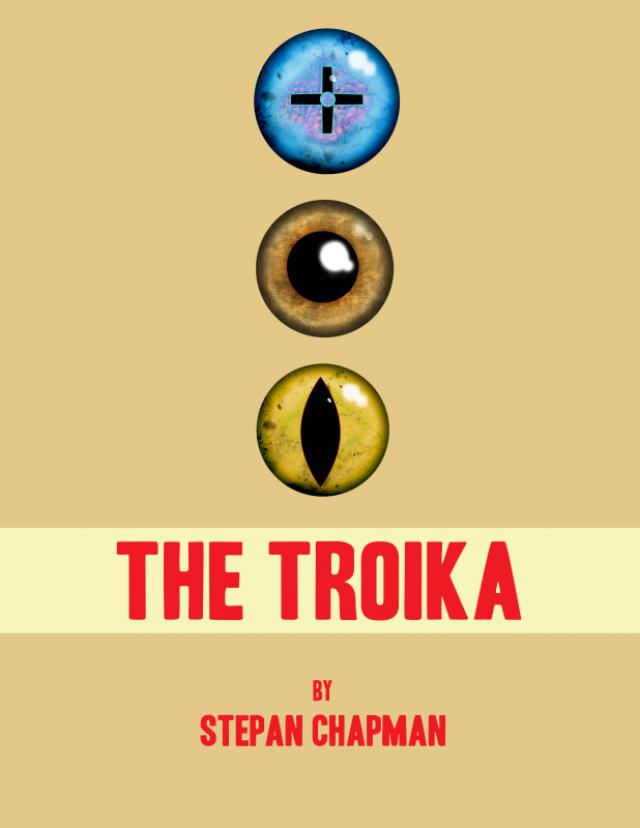
The Troika
Stepan Chapman
This edition published in association with Cheeky Frawg Books
by Ministry of Whimsy Press (an imprint of Wyrm Publishing).
Copyright © 1997, 2012 by Stepan Chapman.
Ebook design by Neil Clarke.
Cover Art © 2012 by Jeremy Zerfoss.
ISBN: 978-1-890464-17-2 (ebook)
ISBN: 1-890464-02-03 (trade paperback)
Originally published in trade paperback by Ministry of Whimsy, 1997.
Excerpts from this novel, in somewhat altered form, have previously appeared in: The Chicago Review, Cyanosis, Fantastic Worlds, The Hawaii Review, Leviathan #1, New Pathways, Orbit #13, Orbit #17, Orbit #20, Potpourri, The Univers Anthology (France), The Wisconsin Review, and Zyzzyva.
All rights reserved. No portion of this book may be reproduced by any means, mechanical, electronic, or otherwise, without first obtaining the permission of the copyright holder.
www.cheekyfrawg.com
www.wyrmpublishing.com
Contents
Introduction: The Resurrection of a SF/Fantasy Classic
by Jeff VanderMeer
PART ONE: A Family Illness
one: The Desert
two: Trade-Ins
three: The Chosen Donor
four: Desertion
five: Storm Center
PART TWO: Relapse
six: The Fallen Woman
seven: Assemblies
eight: The Kidnapping
nine: Sirocco
PART THREE: Signs of Recovery
ten: Spraying For Bugs
eleven: The Frozen Mammoth
twelve: The Hush
thirteen: Low Pressure Area
PART FOUR: The Cure
fourteen: The Singer
fifteen: The Last Judgment
sixteen: Autopsy In Transit
seventeen: Dust Storm
About the Author
INTRODUCTION: The Resurrection of a SF/Fantasy Classic
by Jeff VanderMeer
Stepan Chapman may well be one of North America’s last true fabulists—a storyteller who mixes myth, science fiction, fantasy, and the surreal into a rich tapestry of dark, ironic, and darkly humorous stories. His first story, bought by the legendary John Campbell, was published in the December 1969 Analog SF Magazine, followed by four appearances in Damon Knight's prestigious Orbit anthology series. More recently, Mr. Chapman has published stories in a number of prestigious literary magazines and avant garde publications, with a chapbook Danger Music (Ten Fables) and a collection Dossier.
But his most famous creation is the novel The Troika, which received wide-spread critical acclaim and won the Philip K. Dick Award after being published by my Ministry of Whimsy Press in 1996. I first read the novel after Chapman submitted two parts of it as stand-alone stories for the Leviathan anthology series. The first segment made no sense out of context but I still felt it was brilliant and asked to see more. The second, “The Chosen Donor,” made it into the first volume of Leviathan and at that point Chapman revealed it was part of what he called “my unpublishable novel,” rejected by over 120 publishers. He then sent me The Troika to read.
Daunted by the prospect of an “unpublishable” novel, I was somewhat leery about reading it, even though I’d loved the excerpts. But before I knew it, I had read through the first three chapters. Then six chapters. Then nine chapters. In short, I finished The Troika in one night—I simply couldn't stop reading it. When I had finished, I sat back in disbelief—disbelief that the manuscript had not interested even one publisher (something of a literary crime, in my eyes). Added to my disbelief was the cover letter Mr. Chapman had attached, to the effect that eight of the 17 chapters had been published in very prestigious literary magazines and genre anthologies. Since The Troika , to my mind, worked best as a novel rather than a series of short stories, it seemed inconceivable (ridiculous, actually) that Mr. Chapman could not find a publisher!
Simply put, The Troika is a tour de force of sustained surreal science fiction—influenced to some degree by manga—and contains some of the most audaciously imaginative passages I've ever had the pleasure of reading. Although the mordant humor of the novel invites comparisons to Joseph Heller and Terry Southern, it is uniquely “Chapmanesque” in its fusion of mythology, psychology, and the afterlife. Some scenes are magnificent break-neck narratives, while others are whimsical, dark, and shot through with pathos.
The Troika is also that rarest of birds, a truly visionary novel of the surreal that never loses sight of its main characters’ lives. In this case, those characters happen to be a robotic jeep (Alex), a brontosaurus (Naomi), and an old Mexican woman (Eva). If that sounds strange, consider this: the troika is trudging across an endless desert lit by three purple suns. Not only has their journey lasted hundreds of years, but they have no memory of their past lives, and therefore no clue as to how they came to walk the desert. Only at night, in dreams, do they recall fragments of their past identities. To further complicate matters, sandstorms jolt them out of one body and into another (a game of metaphysical musical chairs): Eva falls asleep a Mexican woman only to wake up a jeep.
The novel alternates between dream-tales about the troika’s former lives and their present-day attempts to discover where they are and how they can get out. From this quest form, Chapman has fashioned a poignant and powerful story of redemption in which pathos is leavened by humor and pain is softened by comfort. It is the story of Alex who wanted to be a machine. It is also the story of deranged angels, deadly music boxes, and of the love and desperation that can bind people together.
As importantly, The Troika is a stylistic tour-de-force—it abounds with magnificent prose passages, some of which delight and some of which horrify. One of the cleverest passages describes an alternate theory for why the dinosaurs died out:
The dinosaurs called them The Spoilers. They evolved from the man-of-war and grew huge on the surface of the oceans. They killed by stinging. They were hollow animals, beasts of living origami, with radial skeletons of cuttlebone and opalescent white skins. They rolled up onto the beaches like moving cities, folding into and over themselves. Lifting their minarets against the purple skies, they scoured the continents, consumed the fern forests, slow and hideous and inevitable as doom… In a matter of decades, the Spoilers chewed the Earth down to its rind. They all starved, leaving behind not a single fossil to mark their passing.
This little story is irrelevant to the plot and yet indicative of the novel’s many tangential pleasures, none of which harm the main thrust of the narrative. Chapman is a master of creating backdrops that have real depth and life—the images and ideas he tosses out would be the foreground material in a novel by a less inspired writer.
A good example of Chapman’s stylistic genius can be found in his account of Naomi joining the army. On Chapman’s Earth, the nations with the strongest military might don’t hoard nuclear weapons—they hoard frozen soldiers. The description of Naomi’s initial emersion in a suspended animation tank is worth quoting at length:
Cheated of shivering and cramps. Cheated of pleas and tears. Nothing outside of me, just my brain winding up my spinal cord like a rubber band in a toy airplane. Struggling to squirm out of the rotten, frozen core of that dark, that dark, that dark so cold, you could cut it with knife, a knife, a knife so sharp, it could cut off your thumb, and your thumb so numb, it wouldn’t cut butter, butter, butter so small that it sings in the eye of an icicle, slips through the needle so thin, it would slide off a spoon, and the spoon so hot, it burns a hole in your tongue, and your tongue so wet that it sticks to a frosty parking meter, and there you are, there you are, there you are, stuck. On a city street, in the dirty sleet, stuck by your tongue. And it’s no consolation that you’re one of a series, just one little girl in a row of foolish little girls in blue jackets, all standing on the sidewalk, all spit-glued to parking meters. Because they were all so foolish and also because someone, someone they never see, keeps coming around and putting cold silver quarters in the meters, to avoid little red violation flags and to keep the current running through the meters, so the tongues stay stuck, all those raw, purple tongues of all those little girls, for twenty years. Oh children misled! Said the voice in my head. Beware! Beware! For thou art dead. Beware entrapment by refrigerator. Beware the lid that slams on suffocation. Beware the stinging freezer mites that swarm in the ice cubes that float in the desolate gutters of freezer burn, where no hipboots can call you an ambulance. This is the place of itching, buzzing battery acid, where balloons break like eggshells, and eggshells bend like balloons.
The ability to simulate a mind shutting down, to mix almost-stream-of-consciousness with dead-on metaphors to describe the process of encroaching deep freeze—this ability is what separates a major writer from a lesser writer, a stylist from a technician. This ability, contrary to what they tell you in writing workshops, cannot be taught. It’s a gift to be treasured by readers fortunate enough to stumble upon it. (It’s also, unfortunately, not a quality much prized by commercial publishers.)
Following several break-neck narratives that provide textbook examples of how to create suspense and tension, the denouement of The Troika has a tremendous cathartic effect on the reader, who has shared a harrowing journey with fascinating characters. Portions of the novel remind me of Samuel Beckett, Franz Kafka, early Harlan Ellison, and Philip K. Dick, but, in truth, these are nearly silent echoes, for Chapman possesses the type of originality that places him more e
I hope you enjoy this amazing novel as much as I did, in this new e-book edition that also resurrects the Ministry of Whimsy through Wyrm Publishing. Chapman has revised the novel so that this version serves as the definitive version.
—Jeff VanderMeer, Tallahassee, December 2011
PART ONE
A FAMILY ILLNESS
CHAPTER ONE
THE DESERT
“Once upon a time there were three little sisters,”
the Dormouse began in a great hurry; “and their
names were Elsie, Lacie, and Tillie; and they
lived at the bottom of a well—”
“What did they live on?” said Alice, who always
took a great interest in questions of eating and drinking.
“They lived on treacle,” said the Dormouse, after
thinking a minute or two.
“They couldn’t have done that, you know,” Alice
gently remarked. “They’d have been ill.”
“So they were,” said the Dormouse; “very ill.”
—Lewis Carroll
The three of them were crossing a desert of white sand. They’d been crossing it for as long as they could remember. Today they listened to the wind as they traveled. The wind hadn’t let up all day. It carved ridges in the sand, like isobars on a barometric pressure map.
Two of the suns had set, but one remained in the western sky. It baked the heaps of boulders and the lichens that grew on them. Three sets of tracks stretched across the plain, wavering under a shimmering ocean of air. There were human tracks, tire tracks, and the prints of some huge beast.
The brontosaur’s head hung close to the white sand, swinging to the left and the right on her leathery gray neck. She was forty feet long and fifteen feet tall at the hips. She limped arthritically. Her joints were killing her.
The jeep drove along behind her on its four massive wheels on their independent axles. The glassy black panels of its photovoltaic collectors were angled out above its back to catch the last of the day’s light. Its drive chain felt sluggish. Its turbines whined, complaining of the heat.
The old Mexican woman walked behind the jeep. Her skin was the color of terra cotta, and her hair was as white as snow. She wore canvas shoes and drab green coveralls with many zippered pockets. Over her eyes, she wore tinted glasses with orange lenses, rims of copper wire, and side screens of copper mesh.
Her name was Eva, and she was more than half mad. Some days she walked in small circles for hours, twisting up her hair and talking to herself. When she did, Alex and Naomi would have to wait for her to snap out of it. Alex was the jeep. Naomi was the brontosaur.
They were all incredibly ancient. Their earliest memories dated back to the Twentieth Century. Alex claimed to be the eldest. On the face of things, you’d expect a brontosaur to be older than a jeep, but Naomi agreed with Alex and maintained that she, Naomi, was the youngest.
None of them seriously believed the stories they told themselves about themselves. They’d forgotten where they came from. They also didn’t know where they were. The desert crossing had been going on this way for centuries.
Triads, Alex thought to himself. I need more triads. Animal vegetable mineral, done that. One had her heart cut out. One got locked in a freezer. One gnawed off his own paw. Hah!
Naomi swung her muzzle toward the old woman. What is Father talking about? she asked.
Don’t ask me! Eva told her. How the fuck would I know? Ask him yourself, you fucking pinhead.
Yes, Mother, thought Naomi.
She’s in a snit, put in Alex.
She’s always in a snit, thought Naomi. She should be put to sleep.
Painlessly? asked Alex. Or after torture? Naomi chewed a ball of cud and considered the question.
The wind whispered over the ridges of the white sand. Alex drove around Naomi and took the lead. Eva went on walking behind the others. It gave her something to look at, other than sand patterns, sandstone outcrops, and lichens. The last of the suns was slipping down behind a mesa. Soon the air would cool off. Then the three of them would stop for the night.
The behavior of the three suns was erratic. One of them was liable to rise while another was setting, while the third hovered at high noon for days on end. At other times they would come close to synchronizing. There seemed to be little pattern in their movements. There seemed to be only confusion.
Eva stumbled over a rock and looked down. Every stone had its own spattering of lichen—burnt orange or pale aqua.
The brontosaur marched on in the failing light, tears leaking slowly from her eyes, suffering the stiffness of her joints. Years of exposure to sun and wind had weathered her sleek hide into rutted tree bark that was stretched like a rickety tent over her spine and ribs. She swallowed her cud and winced from a pain in her hips, pulling her whiskery muzzle back from crooked brown teeth and shrunken purple gums.
Inside the jeep, Alex freeze-framed his optical input of Naomi’s grimace and compared it to a reference still from twenty years earlier. Yes, those gums were definitely receding. The ancient beast had never looked worse. She was a ruined specimen. And with Alex’s luck, he’d wake up tomorrow inside her head. What a life!
In Alex’s view, they must all have gone mad. For whatever reasons, they were now insane. From the heat, or from the cold, or from the isolation or the crowding or the storms. Probably from the storms. What the storms did would drive anyone mad.
The sand whispered past beneath his tire treads. The wind sucked at his solar panels, which were folded flat to his back now, like glossy black beetle wings. His turbines droned like a jar of cicadas. As he bounced across some limestone, his tires scraped their wheel wells. His shock absorbers were thoroughly shot.
Alex had a theory that he’d been born as a man, a fragile construction of bone and jelly. In the laminated circuitry of his mind, he would come across disconnected snatches of the man’s life, like scissored clips from some grainy old newsreel. Alex wondered what had become of that man.
Working from his freeze-frame of Naomi, he traced the contours of her head into his file of mechanical drawings, white on a field of blue. He simplified her saurian anatomy into volumes of solid geometry—direct view, side view, overhead. Alex enjoyed building scale models in his brain. It was one of his hobbies. But it was hard for him to concentrate with Eva babbling to herself.
I can’t stand any more of this, she told herself. It never ends. It won’t leave us alone. He must be mad. No he can’t be mad. He’s dead. Machines don’t go mad. And Naomi isn’t mad, she’s just a retard. So I must be the mad one. It must be my fault. Oh, Naomi! If only we could be rid of him at last. You and I could be so happy. But there’s nothing I can do. He said he would kill me, the bastard. He promised me, Naomi. He promised. Just a lot of big talk.
Eva lengthened her stride, overtook the brontosaur, and walked close behind the jeep, feeling the sand in her shoes. Naomi cocked one eye at her. Eva was shouting at Alex in her head.
Shift it to third, Shithead! You’re fucking up the transmission! Shift into third!
Go get fucked, thought Alex. Don’t mind me. I’ll wait until you’re done. Please. Climb on your pet lizard, squirm around, make noise, whatever it takes. In essence, Eva, in brief—go fuck yourself.
She’s a better fuck than you’ll ever be, thought Eva.
The jeep braked its wheels abruptly. Eva, walking behind it, stumbled into its rear bumper. It revved its rotors, shifted into reverse, and charged at her. She scrambled sideways before it could pin her under a tire. Alex laughed and rolled off in a cloud of white dust.
Naomi could feel her mother’s anger constricting the veins inside her own skull. Please, Mother. Please, Father. Please don’t quarrel. A storm is on its way. Let’s just be quiet and keep moving.
Naomi was correct. A storm was moving toward them across the desert. A storm had caught up with them every day around sundown for several days running. The storms were always painful. When Alex and Eva were fighting, they were especially painful.









