

Outcaste, p.1
Outcaste, page 1


Praise for Outcaste
“In Outcaste, Sheila James has delivered a profound novel that explores the contradictions of faith, cruelties of politics, and long-lasting ramifications of India’s caste system. Memories and secrets are passed down from one generation to the next and woven into the fabric of historical events, creating a rich tapestry where ordinary yet unforgettable women cheat fate and circumstance to choose what their futures will hold. A moving story of hopelessly tangled family dynamics held together by reckless hope.”
— Anuja Varghese, author of Chrysalis
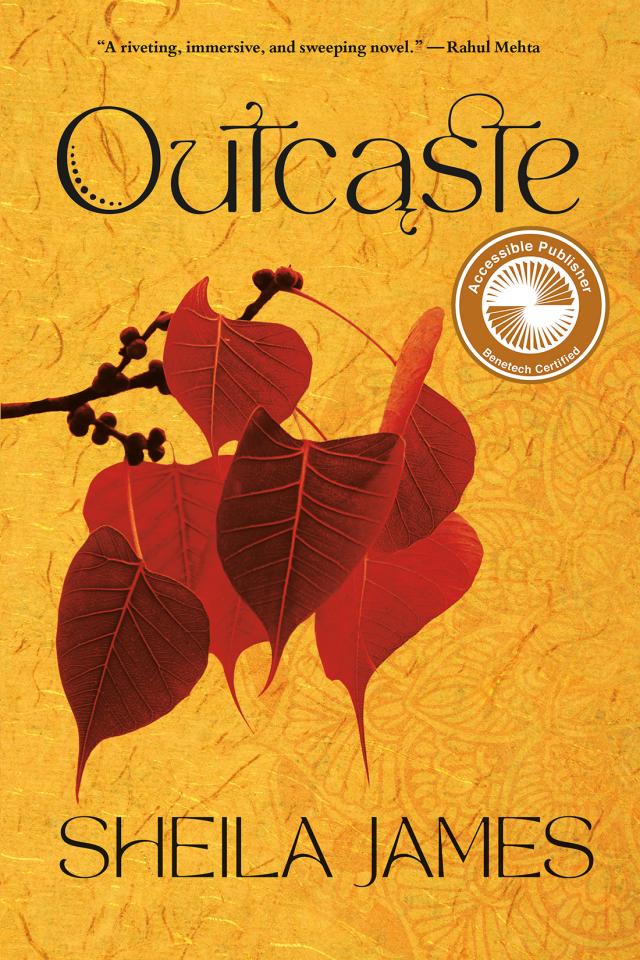
“Outcaste is a riveting, immersive, and sweeping novel filled with vivid descriptions and unforgettable characters. Both epic and intimate, this novel asks big questions about how we forge our futures and the ghosts we leave behind. I fell in love with these characters and learned about a chapter in Indian history about which I knew nothing. A powerful and absorbing read.”
— Rahul Mehta, author of Quarantine
“Outcaste is a deep, layered, and beautiful novel about a family and nation fractured by and freeing itself from colonization, patriarchy, and oppressive traditions. The writing is masterful, with James skillfully unspooling the story's secrets bit by bit. This book will stay with me for a long time.”
— Farzana Doctor, author of Seven
Also by Sheila James
In the Wake of Loss
Outcaste
SHEILA JAMES
GOOSE LANE EDITIONS
Copyright © 2024 by Sheila James.
All rights reserved. No part of this work may be reproduced or used in any form or by any means, electronic or mechanical, including photocopying, recording, or any retrieval system, without the prior written permission of the publisher or a licence from the Canadian Copyright Licensing Agency (Access Copyright). To contact Access Copyright, visit accesscopyright.ca or call 1-800-893-5777.
Edited by Bethany Gibson.
Copy edited by Jill Ainsley.
Cover design by Julie Scriver, with images from iStock.com.
Page design by Julie Scriver, typeset in Bembo Book, with titling in TAN - Mon Cheri.
10 9 8 7 6 5 4 3 2 1
Library and Archives Canada Cataloguing in Publication
Title: Outcaste / Sheila James.
Names: James, Sheila, author.
Identifiers: Canadiana (print) 2023056898X | Canadiana (ebook) 20230569013 | ISBN 9781773103020
(softcover) | ISBN 9781773103037 (EPUB)
Subjects: LCGFT: Novels.
Classification: LCC PS8619.A655 O98 2024 | DDC C813/.6—dc23
Goose Lane Editions acknowledges the generous support of the Government of Canada, the Canada Council for the Arts, and the Government of New Brunswick.
Goose Lane Editions is located on the unceded territory of the Wəlastəkwiyik whose ancestors along with the Mi'kmaq and Peskotomuhkati Nations signed Peace and Friendship Treaties with the British Crown in the 1700s.
Goose Lane Editions
500 Beaverbrook Court, Suite 330
Fredericton, New Brunswick
CANADA E3B 5X4
gooselane.com
for
Nalin and Jugal
“I am no longer accepting the things I cannot change.
I am changing the things I cannot accept.”
— Angela Davis
Contents
Prologue, 1952
Mahbub Nagar
Part One, 1997
1. Toronto
2. Korampally
3. Hyderabad
Part Two, 1947
4. The Village
1997 — The Krishna Lodge
5. The Landlord’s House
1997 — The Thatched Hut
6. The Harvest
1997 — The Crossroads
Part Three, 1948–1955
7. Respectability
1997 — The Well
8. Revolution
1997 — The Prayer Wall
9. Responsibility
1997 — The Tea Room
Part Four, 1965–1985
10. Childhood
1997 — The Peach House
11. Separation
1997 — The Bridge
12. Reckoning
Part Five, 1997
13. The River
Epilogue, 2010
Toronto
Acknowledgements
Author’s Note
Glossary
Prologue, 1952
Mahbub Nagar
Malika aimed her rifle. She lay astride the branch of a banyan tree with her sari hitched high above her knees. Her thighs circled the limb as her belly pressed against its smooth bark. A canopy of leaves hid her from the hundreds of people gathering on the road below. They were waiting to glimpse the new district collector in his motorcade. Malika was also waiting.
It was rumoured that the district collector was travelling with his family. With young children, perhaps the same age as hers. If his children were present, they would certainly witness the death of their father, but they would survive.
The car came into view. The district collector was seated diagonally behind the chauffeur, alone in the back, perfectly positioned to take the shot in his left temple. An easy kill. No unintended casualties.
Malika drew in her breath as tension knotted between her shoulder blades. The stock of her rifle grazed her cheek. Just as her finger pulsed the trigger, the district collector turned his head upwards. Malika recognized Rayappa.
Part One 1997
* * *
1. Toronto
Seventy-year-old Irwin Peter presses his forehead against the cool windowpane. From his room in the Queen Street Mental Health Centre, he looks across Toronto’s busy thoroughfare to a rundown nineteenth-century brick row house. Now painted white, its first floor converted into a used-clothing store. The third-storey attic is where his daughter Jaya lives. He focuses on the dormer window and imagines her there. Quiet and contained. He recalls how her clear brown eyes would dart back and forth, betraying her otherwise calm countenance. She was the practical one. The reliable one.
Irwin recreates her apartment as he last saw it twelve years ago. The front room choking on light. The steam rising from the chai served in a stainless-steel cup. The distraught face of his other daughter, Anasuya. The widened eyes of his teenaged granddaughter, Anya. Jaya had not been there that day. If she had, perhaps he might not be here. And the others would be alive.
Irwin exhales. He feels the warmth of the sun on his forearm, coaxing him to leave this place. But where will he go? To Jaya, of course, the only one left. He had killed the others.
He wonders if Jaya has forgiven him. Whether she will come to pick him up. His attendant has reassured him that they have contacted her.
Irwin withdraws from the window and sits on the edge of his bed. His feet dangle inches from the floor. His thick, calcified toenails stare up at him. They remind him to put on his socks and then his shoes and take the necessary steps to leave. He has packed his canvas bag with his clothes and wonders how he will fit in his notebooks, neatly stacked on his bed beside him.
From his breast pocket, Irwin pulls out a gold pocket watch. He cradles it in his palm and looks at the time: 5:05. It is always 5:05. Morning or evening, who is to know? The clock on his wall indicates the correct time: 8:45 a.m. His attendant will soon be here to escort him out. Feeling nauseated, Irwin slips the watch back into his pocket. Instead of reaching for his medication, he opens a notebook and reads a reassuring list of his possessions:
1. One gold pocket watch
2. One Timex wristwatch
3. 24 Hilroy notebooks
4. Two Bic ballpoint pens
5. One Colgate toothbrush
6. Seven pairs of Stanfield’s boxer shorts
7. Seven Stanfield’s undershirts
8. One pair of pyjamas
9. Three Arrow shirts
10. Two pairs of trousers
11. One leather belt
12. Four pairs of socks
13. One pair of Adidas sneakers
14. One overcoat
15. One canvas travel bag
16. The Sunderlal Report dated 1952
17. A yellowed Toronto Star newspaper dated June 24, 1985
18.
Irwin cannot progress to the next item on the list. He remembers living in Nova Scotia. His car getting stuck in the snow. Like the spinning tires, he is desperate to gain traction.
He stalls again. If only he hadn’t paid a visit to Jaya and Anasuya’s Toronto apartment on June 23, 1985. If only he had waited for Jaya to return home. But Anasuya had offered him a cup of chai and repeatedly asked why he had come. Then it all came out. He told her everything he knew about Jaya. After that, Anasuya did not invite him to stay, nor did he want to with all that had gone on. He couldn’t stop thinking about the two of them. All these years, it had been happening right under his nose, apparently with his blessing. Isn’t that what Anasuya had inferred? One of the last things she had said to him?
“But Papa, you knew.”
How could he have known? How could he have not?
After the visit to their apartment in 1985, Irwin returned to his motel, relieved that Anasuya had taken the airline tickets that he bought for her and Anya to go to Hyderabad. He gave thanks to God that Anasuya and Jaya would be separated. He ordered takeout, a meal of steak and fries, and fell asleep listening to the radio. Then came the breaking news around 2 a.m. He woke up. Had he heard right? Was it a hoax? Air India Flight 182 had disappeared off the radar at 7:09 :58 Greenwich Mean Time.
In the morning, after a sleepless night, Irwin frantically checked the papers for the passenger list. Three hundred and twenty-nine people had been laid out in alphabetical order. He began reading: mostly Indian names, all that was left of the lives that were lost.
The newsprint had left an inky residue on his fingertips so he slid a ruler down, down, down each rung of names, until he found hers. Evelyn Anasuya Peter. But where was Anya’s name? Erased from the record.
Anasuya and Anya, his daughter and granddaughter were gone. Two people whom he loved and whose love was mutually and undoubtedly shared.
Later that day, housekeeping opened the door to find Irwin unconscious on the floor. They called 9 1 1, triggering the events that saw Irwin committed to the Toronto Queen Street Mental Health Centre.
Irwin closes the notebook, while somewhere in the Atlantic, at the scene of the tragedy, the last remnants of Anasuya’s body meld into the seabed.
* * *
Jaya stands at her south-facing kitchen window. The October sun pours in. It is unrelenting. Jaya closes the blinds and separates two slats with her thumb and forefinger through which she surveys the street. She observes the familiar rush of traffic: streetcars clanging, cars and bikes vying for space, pedestrians hurrying along the sidewalks. From this spot in 1987, Jaya had watched activists gather on the lawn of the Mental Health Centre, known to locals as 9 9 9. They held placards in protest of the use of electroshock treatment. But it is not traffic or the possibility of protests that draw Jaya to her window each morning. Instead she waits for patients to file out of the hospital for their morning walk, looking for a signal from her father that never comes. She watches until 8 a.m. sharp, whether she sees him or not. Then she leaves for Uncle’s Spice Bucket, KFC’s “ethnic” competition. Jaya spends her days grinding fresh spices and mixing masala for various chicken recipes and returns home by 9 p.m. After eating a simple supper consisting of one chapati and a vegetable curry, she cleans the kitchen and the living room, dusting shelves filled with books she will never read. From between the two bookshelves, Jaya pulls out the four-runged wooden ladder, once part of Anya’s bunkbed set. Jaya climbs up to retrieve Anasuya’s urn. She polishes its brass exterior, ensuring the dimpled pattern gleams. Replacing the urn and ladder, Jaya retreats to the window to stare at the lit-up rooms in the hospital. Part of a ritual she has practised for the past twelve years. Years that have disappeared, weightless and colourless.
But today is different. Jaya has taken time off work to help bring Irwin back into her world.
When staff from 9 9 9 telephoned to inform her of Irwin’s release, Jaya assured them that she would take care of him. She surprised herself. During his internment, she had attempted to see him but he had refused. She bought him new clothes periodically, inquired about his medication, and dropped off freshly prepared meals on special occasions. Jaya put the bank in charge of Irwin’s finances and asked former neighbours to help rent the farmhouse in Antigonish. She deposited the income into Irwin’s bank account and never touched it. Periodically, she would receive updates about Irwin’s progress and was assured that he was well taken care of. She did the minimum. She did the right thing.
Jaya could not help but think that Anya’s return was due to her good deed in agreeing to look after Irwin. How could it be otherwise? Only two weeks after Jaya offered to take Irwin in, Anya telephoned. It was the first time she had heard Anya’s voice in twelve years.
“Where’s Thatha? I went to the farmhouse and strangers opened the door.”
“Anya, are you okay? Where are you?”
“I’m in Cape George. How else could I go to the farmhouse.”
Anya had found her way back from New York City to Antigonish, Nova Scotia, thinking her grandfather would be there. Jaya explained that Irwin was still a patient at 9 9 9 and would soon be discharged, and asked Anya to help move him into the apartment. Jaya needed Anya to do what she could not. Speak with Irwin. Show him kindness. Be his family.
“He will want to see you. He loves you.”
Anya refused Jaya’s offer of a bus ticket and hitchhiked from Antigonish to Toronto, arriving at the Queen Street apartment only two days ago.
Jaya was still not ready to face Irwin. She asked Anya to write a letter of introduction, indicating that Anya, and not Jaya, would pick Irwin up. Jaya scrawled her signature at the bottom of the page and sent Anya across the street.
Jaya watches from the window, hoping to see Anya returning with Irwin. After twenty minutes of waiting, she finally gives up and releases the slat of the blind. It springs back into place, shutting out the sun. Jaya turns to the table where an airmail letter from India sits unopened. Beside it is a shoebox full of picture postcards sent by Anya after she left home. Each time a postcard arrived, Jaya would carry it to work and ask a co-worker to read it out loud. She explained how she dreaded the possibility of learning news that she couldn’t bear alone. But these postcards had only disclosed the latest city where Anya was living: Boston, New York, Chicago, and some other cities Jaya had never heard of. Sometimes Anya would write that she was playing drums for a house band or was on tour with a new group. Anya never included information about whom she was with or when she was coming back. Never a return address.
Jaya picks up the letter from India. Anya had brought it with her from Antigonish along with other mail that the tenants hadn’t redirected. The address is in English, but the name is written in the curvy script of Telugu, her mother tongue. Irwin would know how to read this. Jaya carefully places the envelope on a stack of postcards and dusts off her hands, as if the letter were precious or poisoned. Either way, untouchable.
* * *
Anya sits in the waiting room at 9 9 9, re-reading Jaya’s letter. Irwin is finally led in by an attendant. Her grandfather looks frail. His clothes are too big for him. His head, walnut brown, is bald except for a short white fringe from ear to ear. His cheeks have lost their friendly fullness, but his amber eyes are still bright as ever.
Anya waves. “Thatha!”
The attendant directs Irwin towards her. But her grandfather is hesitant. He seems afraid. Of course he would be, Anya thinks. She was only eighteen when they last saw each other. That crazy day in the apartment when everything changed.
Irwin turns away from Anya.
“It’s okay.” The attendant places his hand firmly on Irwin’s shoulder. “Your daughter Jaya is here.”
“No, no. I’m Anya. His granddaughter.” Anya hands the letter to the attendant.
She tries to embrace Irwin but he backs away, gripping the attendant’s arm.
Anya persists. “Don’t worry, Thatha, I’ll be taking you. Is that your only bag?”
After reading Jaya’s letter, the attendant slowly pries Irwin’s fingers off his arm and hands Anya an 8 inch by 10 inch envelope.
“His medical records, medications, and instructions are inside. He’s fine. Just nervous about the transition.” The attendant returns to his work, leaving Irwin in Anya’s care.
Irwin is trembling. Anya takes his hand.
“Jaya?”
“No, silly. I’m Anya.”
She reverts to her childhood voice and taps out a rhythm on the back of his hand and sings “Dum maro dam,” an old Hindi film song from the seventies. “Don’t you remember me? Your chinnie sitaphal.” Anya uses the nickname he gave her, to jolt his memory.
“You are here.”
“Of course I am.”
“You are alive.”
Anya realizes he is confused.






