

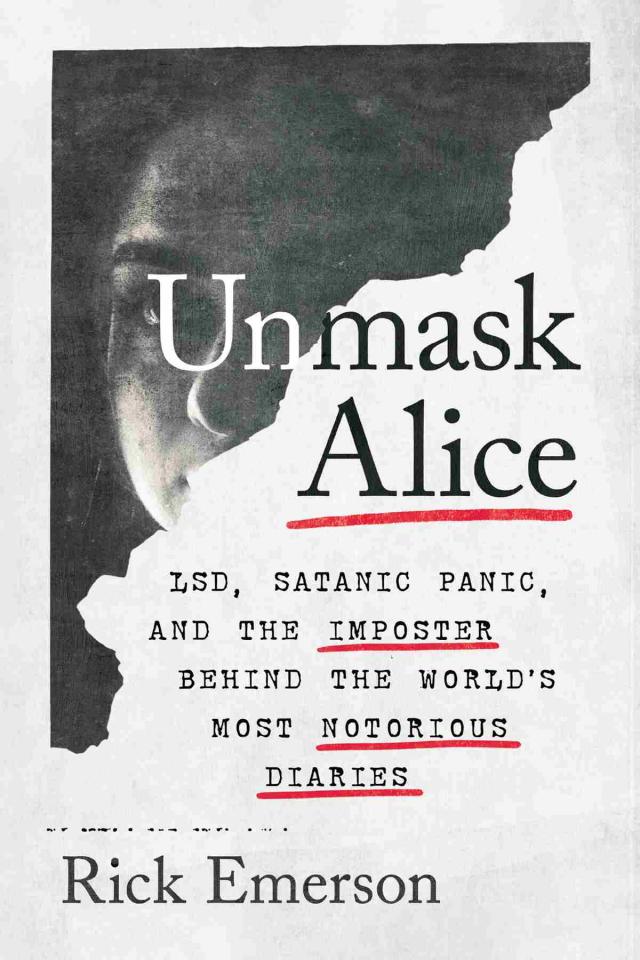
Unmask alice, p.1
Unmask Alice, page 1


Praise for Unmask Alice
“Deeply reported, deftly written, and laced with real moral outrage, Rick Emerson’s Unmask Alice shines withering light on some of America’s most treasured, yet nonsensical crusades. Starting with the story of Go Ask Alice, Emerson connects the War on Drugs to the Satanic Panic and reveals the real motivation of their most fervent crusaders: money and power.”
—Peter Ames Carlin, New York Times bestselling author of Bruce and Sonic Boom: The Impossible Rise of Warner Bros Records.
“Unmask Alice is captivating . . . and reads like a mystery novel. It keeps you thinking about what has (and hasn’t) changed in the last fifty years.”
—Heather Mayer, historian, author of Beyond the Rebel Girl
“Unmask Alice is an eye-opening, shocking, and at times harrowing tale of deception, delusion, and exploitation. Veering from entertaining to stomach-turning to jaw-dropping, Unmask Alice is a must-read for any child of the 70s, 80s, or 90s. The truth will set you free, and will keep you turning the pages late into the night. If you’ve read Go Ask Alice, you have to read Unmask Alice.”
—Dan Gemeinhart, award-winning author of The Remarkable Journey of Coyote Sunrise and The Midnight Children
“Rick Emerson’s fascinating book, Unmask Alice, reveals the unsavory truth about Beatrice Sparks and her influential publications, Go Ask Alice and Jay’s Journal. Emerson skillfully and credibly links Sparks’s stubborn ambition to become recognized as an author to the destruction of lives and a period of Satanic worship hysteria.”
—Jana Brubaker, author of Text, Lies and Cataloging
Unmask
Alice
Unmask Alice copyright © 2022 by Rick Emerson
All rights reserved. No part of this book may be used or reproduced in any manner whatsoever without written permission of the publisher, except in the case of brief quotations embodied in critical articles or reviews.
BenBella Books, Inc.
10440 N. Central Expressway
Suite 800
Dallas, TX 75231
www.benbellabooks.com
Send feedback to feedback@benbellabooks.com
BenBella is a federally registered trademark.
First E-Book Edition: June 2022
Library of Congress Control Number: 2021057358
ISBN 9781637740422
eISBN 9781637740439
Editing by Vy Tran
Copyediting by Ginny Glass
Proofreading by Karen O’Brien and Michael Fedison
Text design and composition by PerfecType, Nashville, TN
Cover design by Emily Weigel
Cover image © Shutterstock / Ihor Nebesnyi (girl) and nito (texture)
Special discounts for bulk sales are available. Please contact bulkorders@benbellabooks.com.
For my sister, who taught me to read.
And for my mom, who taught me the rest.
Contents
Author’s Note, Part One
PROLOGUE: The Pretender
PART ONE: About a Girl
PART TWO: The Boy Who Died
PART THREE: Gods and Monsters
PART FOUR: Contagion
PART FIVE: Shine a Light
EPILOGUE: After Forever
Author’s Note, Part Two
Appendix
Acknowledgments
Photo Credits
The living, if falsely defamed, have recourse to the laws of defamation. But the dead, if falsely maligned, have no recourse among the living through those laws.
—American Law Institute, Restatement (Second) of Torts § 560 (1977)
Truth has to change hands only a few times to become fiction.
—Pleasant Grove High School yearbook (1971), page 43
Author’s Note, Part One
There are two kinds of people in this world: people who skip ahead to see how it all turns out—and people who take the ride, trusting that everything (or most things) will eventually be explained.*
I understand the “jump to the end” compulsion, especially when so many books, podcasts, documentaries, and other deep dives promise to finally reveal The Whole! Shocking! Truth! . . . then sputter their way to a noncommittal shrug.
Arggh, the consumer seethes. I just wasted nine hours of my life to learn that the jury’s still out on Bigfoot.† Get burned often enough and the urge to fast-forward can feel overwhelming.
There’s another reason people skip ahead (or to the comments), and that’s sourcing. At some point, even the most credulous reader can wonder, How does he know the car smelled vaguely of almonds? Or, How can he possibly say what the river looked like on January 3, 1970? At such moments, it’s tempting to rush to the internet, where someone is always waiting to answer your questions.
I won’t order you to stay offline until you finish this book, and I won’t begrudge the occasional doubt. (As you’ll soon see, blind faith—in anything—is a bad idea.) That said, if you buckle in and let the story take the wheel, I think you’ll be glad you did. When it’s all over, I’ll explain the sourcing, the background, the improbable details—everything.
Until then, a few quick notes:
•This is a true story. In a book of any length, errors are almost unavoidable, but to the best of my knowledge and ability, what follows is both accurate and morally honest. Any factual mistakes, even if they came from someone else, are ultimately my responsibility.
•No dialogue is invented. If it’s in quotes, someone said it.
•Inner monologues and paraphrased statements are italicized and come from diaries, written records, interviews, and other concrete research.
•Journal entries, news blurbs, and the like are edited for clarity and brevity (i.e., to keep this book a manageable length), but I’ve preserved their meaning and intent.
That’s it for now. See you on the other side.
—Rick Emerson
* In the twenty-first century, “skip ahead” takes many forms, including “skim Wikipedia during breakfast” and “trust the headline on BuzzFeed.”
† Or in my case, D. B. Cooper. You’d think I’d eventually stop falling for the “have authorities finally found their man?” gambit, but no. I bite, every single time.
PROLOGUE
The Pretender
Wednesday, November 6, 1996
The grand ballroom of the Waldorf Astoria smells like perfume and coffee, and everyone is applauding.
At center stage, Toni Morrison receives a large bronze medal on a bright blue ribbon. Like the evening’s other winners, Morrison will also get ten thousand dollars and (fingers crossed) a sales bump.
It’s a perfect finale for the Forty-Sixth National Book Awards, the embodiment of their mission to “celebrate the best of American literature.”
“I want to tell two little stories,” Morrison says as the clapping fades. “The first, I heard third- or fourth-hand . . .”
As Morrison speaks, a green-eyed woman at table thirty-seven listens politely. Like Morrison, she’s an author, but she’s also one of five judges in a brand-new category: Young People’s Literature. That award already happened, so now she just sits, waiting for things to wrap up.
For the woman at table thirty-seven, grousing would be easy. She’s sold more books than Toni Morrison. In fact, she’s sold more books than all of the winners combined. Her second book is still moving a thousand copies a week—more than four million so far. Not bad, considering it came out twenty-five years ago.
But no one asked her to speak tonight.
That’s how it’s always been. Ignored. Pushed aside. Deleted. Her biggest hit doesn’t even have her name on it, for Pete’s sake.
The agent’s fault. Why did I listen to him?
No matter. Tonight is a victory, the payoff for decades of hustling.
Later, at the afterparty, she’ll need to be careful. Nothing about her college degrees, or her fascinating career as an adolescent psychologist. (Or was it psychotherapist? So hard to keep track.)
And no mention of the dead boy. Not in this crowd.
She knows how much damage a writer can do.
Part One
About a Girl
She’s Leaving Home
June 1971
In the sixth-floor city room of the Miami News, Nicolette Handros stared at the little yellow paperback. It was an ARC, or “advance review copy,” which meant it was bare bones. No artwork, no dust jacket, no price tag. Just a bright yellow cover with five red words:
Go Ask Alice
Author anonymous
Below this, a typed 3" × 5" card was glued to the front:
This special pre-publication paperback book that you hold in your hands is, in our estimation, one of the most gripping, terrifying and socially important books that we at Prentice-Hall have ever published.
We feel confident that you will share our enthusiasm and our dedication to bring the published edition to the attention of every parent and young person in your community.
Handros hadn’t asked for this book—it had just arrived, landing at the newspaper with a pile of other promo titles, all of them angling for a little exposure.
Handros was a staff reporter, and her usual beats were drugs and mental health (unofficially, “misfits and crazies”), but the Miami News was a second-place paper, so everyone did extra work. When a book caught your eye, you wrote a review, and it usually ran the same week.
Handros flipped through the paperback, checking the length. It was brief, with spacious text, a book you could read in one evening. It
Go Ask Alice is based on the actual diary of a fifteen-year-old drug user. It is not a definitive statement on the middle-class, teenage drug world. It does not offer any solutions.
It is, however, a highly personal and specific chronicle. As such, we hope it will provide insights into the increasingly complicated world in which we live.
Names, dates, places and certain events have been changed in accordance with the wishes of those concerned.
The next 159 pages were a slideshow of personal destruction. Lured into drug use by unsavory friends, a bright, middle-class teenager succumbs to addiction and impulse. She runs away from home but finds only heartache: a wasteland of pushers and prey. As things unravel, the diarist suffers a horrifying breakdown and lands in a psychiatric ward. She vows to start over, but the darkness soon returns; she dies at seventeen, leaving only the diary behind.
Reading Go Ask Alice, Nicolette Handros grew uncomfortable, like she was peering through somebody’s window. The writing was clunky and unguarded, the kind of thing meant to stay private.
This has to be real, she thought.
Handros knew about reality, especially its uglier forms. In the past twelve months, Dade County’s crime rate had spiked, and things were getting scary. Everyone seemed to be high, or packing heat, or both. That included children: expulsions were up by 60 percent, and it wasn’t making a dent. Across Miami, kids slashed each other with razors, assaulted teachers, and waved handguns in school hallways.
It wasn’t just Florida. For a decade, the nation had slid toward the brink, pulled back, and slid again. JFK and MLK . . . then RFK. The Manson killings. The Manson trial. Kent State. Then the Pentagon Papers: a massive leak showing that the Vietnam War was unwinnable, and that the government had known it for years.
Things felt dangerous, like an ongoing earthquake. By mid-1971, homegrown bombings were hitting America five times a day, tearing through banks, police stations, and the US Capitol.
Even criminals who were caught couldn’t be controlled. In Attica, New York, more than a thousand prisoners rioted, taking four-dozen hostages. When police finally stormed the gates, thirty-three inmates and ten hostages were killed—all but one by the cops themselves.
It was overwhelming. You couldn’t begin to process a thousand bombings, or a thousand angry prisoners, or—God help you—seven thousand pages showing that the war was a pointless death trip.
But the story of one sad girl? That could break the hardest heart.
Handros fed a sheet of paper into her typewriter and thought about the diary.
“Alice,” she typed, “could be anyone’s daughter.”
In Cincinnati, columnist Terri Loebker read Alice’s shocking conclusion and felt a sudden, empty ache.
I wish I had known her, Loebker thought. Maybe I could have helped her.
Loebker was a high school senior, and a year earlier, she’d joined the Cincinnati Enquirer as a teen correspondent, writing for the weekend edition. It paid almost nothing, but for Loebker, it was a chance to report on a culture in flux. The sixties had torn the nation in two, and Ohio, where National Guardsmen had shot thirteen Kent State students in 1970, still felt divided.
Loebker didn’t drink or get high, but she viewed herself as a hippie, and she grieved for the diary’s anonymous author.
In her October 16 column, Loebker urged every reader to buy two copies of Go Ask Alice: one for themselves and one for a friend.
“Go Ask Alice,” wrote Loebker, “is the deepest insight into drug use ever printed, [and] is recommended reading for both sides of the generation gap.”
For parents especially, that gap had become a canyon. Even obedient children seemed like potential time bombs, and parents braced for the day when things might blow apart.
Instead, more and more teenagers simply disappeared.
Runaways had always existed, but they’d come from predictable places, for predictable reasons. Some were true delinquents: knife-pullers and window-smashers who’d been cutting out since grade school. Some were banished reminders of long-gone wives or husbands. Others were more like refugees—exiled for being pregnant, or being gay, or finally telling a handsy stepfather to knock it off.
Ugly and sad, yes, but also understandable. Sometimes, running was the only real choice.
Then something changed. In 1964, more than two hundred thousand teenagers vanished long enough to be declared missing. The following year, it was close to five hundred thousand, and confusion turned to panic.
It wasn’t just the numbers that had people rattled, it was the teenagers themselves. They weren’t backwater fuckups or terminal crackpots, but honor students and athletes, and they were overwhelmingly female. By 1971, the average American runaway was a white, middle-class, suburban girl who was barely fifteen.
In Boston and New Orleans, they drifted in by the hundreds. In Greenwich Village, cops put the number at twelve hundred a month. And in San Francisco’s Haight-Ashbury district, more than twenty thousand teenagers arrived each year—a virtual army of sad-eyed dreamers.
Most gave up and went home, embarrassed and defeated. The ones who stayed learned how to hustle, and even then, it was hard. Dealers and pimps descended like bats, drinking and draining, then flying away.
When parents described a missing child, the police gave concrete advice. Whatever your daughter weighs, subtract twenty pounds. No one stays healthy out there.
Some disappeared for a weekend, some for several months, and a handful never came back. Most returned within a few weeks, but that was long enough to cause damage—to their parents, to themselves, to anyone who cared.
In Jackson, Tennessee, twenty-four-year-old reporter Delores Ballard started reading Go Ask Alice—and couldn’t stop.
This could be me, she thought. The teenage me, anyway.
It wasn’t the drugs—Ballard had always been straitlaced. It was the madness. The terrible (and glorious) roar of emotions that defined adolescence.
Ballard thought back to her own teenage years, to her own diary. She had felt like one giant nerve ending, and her writing had shown it, all Sturm and Drang and fury and light. Embarrassing in retrospect, but also honest. Maybe embarrassing because it was honest. Teenagers didn’t filter; that was their blessing and curse.
“Alice” (whoever she was) had captured that feeling in language any young woman could recognize, and the resonance made her death even more crushing.
“Alice didn’t know she was writing a book,” said Ballard’s September 5, 1971, review in the Jackson Sun. “She was just one of a million 15-year-old girls who kept a diary; a real, honest-to-goodness teenage diary.
“This book is the most personal, most revealing, and most agonizingly tragic chronicle of drug addiction that has ever appeared in print.
“Go Ask Alice belongs on every school library shelf; it belongs in the hands of every parent of a teenager, and every teenager who is ever tempted to even try the drug route.”
To millions of parents, “the drug route” converged with other, darker paths—low roads that snaked through the heartland, leading young people to corruption and ruin. Those byways were stalked by a shape-shifting monster, a creature that lurked on bright strips of paper or inside pieces of candy. It was odorless and flavorless, and weighed almost nothing, and they said it would eat you alive. It was a chemical demon unleashed by mistake.
Into the Great Wide Open
Friday, April 16, 1943
The laboratory looked more like a country kitchen. Lots of white cabinets and drawers, each with a small black handle. There were low wooden chairs and screenless windows that swung wide open. Rows of corked bottles lined every shelf.
A slender, spectacled man moved here and there, adding, mixing, observing. His head was small and perfectly round, with a layer of short, dark hair. His crisp white lab coat was cinched at the waist. Order and control.
Swiss chemist Albert Hofmann wasn’t trying to innovate. Just the opposite: there was big money in asthma treatments, and Hofmann’s employer, Sandoz Labs, wanted a piece of it. Could Hofmann clone a competitor’s drug? Hofmann thought so, and was synthesizing a plant extract that might do the trick.









