

Whale fall, p.1
Whale Fall, page 1


This is a work of fiction. Names, characters, places, and incidents either are the product of the author’s imagination or are used fictitiously. Any resemblance to actual persons, living or dead, events, or locales is entirely coincidental.
Copyright © 2024 by Elizabeth O’Connor
All rights reserved. Published in the United States by Pantheon Books, a division of Penguin Random House LLC, New York, and distributed in Canada by Penguin Random House Canada Limited, Toronto. Originally published in hardcover in Great Britain by Picador, an imprint of Pan Macmillan, a division of Macmillan Publishers International Limited, London.
Pantheon Books and colophon are registered trademarks of Penguin Random House LLC.
Library of Congress Cataloging-in-Publication Data Names: O’Connor, Elizabeth, [date] author.
Title: Whale fall / Elizabeth O’Connor.
Description: New York : Pantheon Books, 2024.
Identifiers: LCCN 2023029366 (print) | LCCN 2023029367 (ebook) | ISBN 9780593700914 (hardcover) | ISBN 9780593700921 (ebook) Subjects: LCGFT: Novels.
Classification: LCC PR6115.C667 W47 2024 (print) | LCC PR6115.C667 (ebook) | DDC 823/.92—dc23/eng/20230830
LC record available at https://lccn.loc.gov/2023029366
LC ebook record available at https://lccn.loc.gov/2023029367
www.pantheonbooks.com
Ebook ISBN 9780593700921
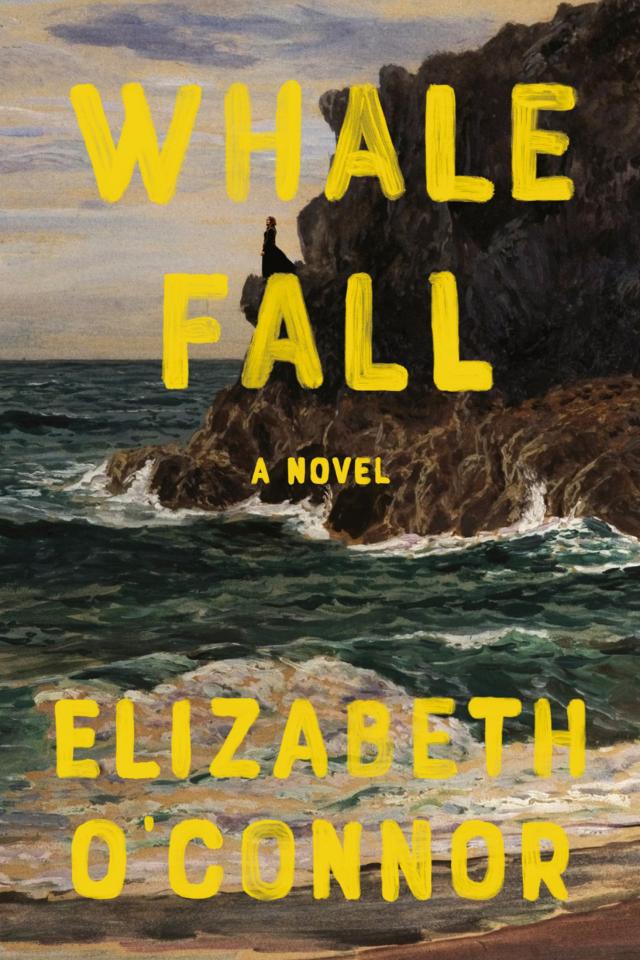
Cover images: North Wales (detail) by Frederick William Hayes.
Photograph © Nottingham City Museums & Galleries / Bridgeman Images; (woman) Malivan Iuliia / Shutterstock
Cover design by Kelly Winton
a_prh_7.0_146935348_c0_r0
Contents
Copyright
Epigraph
Chapter 1
September
Chapter 2
Chapter 3
Chapter 4
Chapter 5
Chapter 6
Chapter 7
Chapter 8
Chapter 9
Chapter 10
Chapter 11
Chapter 12
Chapter 13
Chapter 14
Chapter 15
Chapter 16
October
Chapter 17
Chapter 18
Chapter 19
Chapter 20
Chapter 21
Chapter 22
SJCEG Transcription 13 1.
Chapter 23
Chapter 24
Chapter 25
Chapter 26
Chapter 27
Chapter 28
Chapter 29
Chapter 30
Chapter 31
Chapter 32
SJCEG Transcription 20.
Chapter 33
Chapter 34
SJCEG Disc 1A.
Chapter 35
Chapter 36
Chapter 37
Chapter 38
Chapter 39
Chapter 40
Chapter 41
Chapter 42
Chapter 43
Chapter 44
Chapter 45
November
Chapter 46
Chapter 47
Chapter 48
Chapter 49
Chapter 50
Chapter 51
Chapter 52
Chapter 53
Chapter 54
Chapter 55
Chapter 56
Chapter 57
SJCEG Disc 7.
Chapter 58
Chapter 59
SJCEG Disc 11.
Chapter 60
Chapter 61
SJCEG Disc 16.
Chapter 62
Chapter 63
Chapter 64
Chapter 65
Chapter 66
Chapter 67
Chapter 68
Chapter 69
Chapter 70
SJCEG Disc 16.
Chapter 71
Chapter 72
Chapter 73
Chapter 74
Chapter 75
SJCEG Disc 19.
Chapter 76
Chapter 77
Chapter 78
December
Chapter 79
Chapter 80
SJCEG Disc 22.
Chapter 81
Chapter 82
Chapter 83
Chapter 84
Chapter 85
Chapter 86
Chapter 87
Chapter 88
Chapter 89
A Note on the Text
Acknowledgements
_146935348_
I have looked long at this land,
Trying to understand
My place in it.
R. S. Thomas, ‘Those Others’
Here is an island year. First the sun, and first the spring growing fat with birds. They leave the island to its grey winter and return when shoots appear in the ground. Auks come as dark shapes under the water. Kittiwakes and gannets fall from the skies. We do not notice them at first. The children might chase them on the cliffs, the men fishing might push them away from a net with an oar. By the end of spring they are thrown across the island like shadows. Puffins, sea swallows, little terns. By summer they are raising young, flinging themselves back into the water.
The kittiwakes come closest to our houses, picking food scraps from the middens in the yard. They perch on the roofs: from afar the building is spiked with the grey points of their wings. They live on the roof, covering it in a silver layer of feathers and guano, waking us inside as they squabble and scurry across the tiles. Sometimes they fight mid-air, leaving red smears on each other. They drop fish from their beaks onto the stone yard, which worm into the stone’s small crevices and holes and make them smell rancid for months. The heat only brings them closer: their bird-smells, their calling, their pink-dead young.
In summer, the women of the island repaint the houses white. They go into the limestone cave at the west of the island and chip the rock into powder. My mother would always return with it on her hands, specks trailing everything she touched. Sometimes the pigment turned the paint more yellow, or more blue, than pure white. One year the houses all over ended up a pale rose-pink and it still shows through, in nicks and patches where the outer layers are peeled away.
After summer, the cold circles, then drops like a stone. The birds disappear one by one. They leave their nests on the cliffs with eggs still inside. In autumn, the sea boils like a pot on the fire. The birds pass and the summer is gone.
* * *
—
Winter: we stay near the hearth, sleep in the same bed. The sea sidles up to the door, laps at the edge of the island. There is grey ice at the horizon. The wind makes red meat of us. At Christmas we cook a catch of fish, then butcher a sheep, and throw it into the water. The waves push it back onto the beach again by spring, and the birds arrive to devour it. The sheep are rotated around the island, after they’ve grazed their field to nothing.
September
The whale became stranded in the shallows of the island overnight, appearing from the water like a cat slinking under a door. No one noticed it: not the lighthouse with its halo of light on the water, or the night fishermen searching for whiting and sole, or the farmers moving cattle over the hill at dawn. The sheep on the cliffs were undisturbed. Under the dark water, the whale’s body glowed lightly green.
By the morning it had floated up onto the beach, and lay neatly on its front. Birds gathered above it. The tide brought water over the sand in wide, flat mirrors broken by thin paths of sand. The waves drew around the whale and then out again, like a membrane around its delicate centre.
Some of the fishermen said it had come off course. They saw them out at sea but rarely so close. A few older people said it was some kind of omen, though could not agree on whether it was good or bad. Reverend Jones read the English newspapers most weeks but he said there was nothing that could explain the creature’s arrival. The navy was newly out at sea since the start of the month. He made a vague suggestion about radar and one of the farmers nodded and said, submarines.
Someone brought a large camera down from their house, a box which sat on long wooden legs. The flash made the landscape bleed out.
I was born on the island on 20th January 1920. My birth certificate read 30th January 1920, because my father could not get to the registration office on the mainland before then. There was a great winter storm and no one could leave the island. When we were finally able to cross, my mother used to tell me, the beach was covered in jellyfish, like a silver path of ice. My mother survived the birth, thank Jesus, because no one could have come to help her.
The island was three miles long and one mile wide, with a lighthouse marking the eastern point and a dark cave marking the west. There were twelve families, the minister, and Polish Lukasz who worked in the lighthouse. Our house, Rose Cottage, was set into the side of a hill, where the wind wrapped a fist around it. Tad said the army should have made tanks out of our windows, the way they stood against the weather. The glass had warped and s plintered in places but still held fast to the frame. In the bedroom, at night, you could hear our neighbours’ goats calling out to their young through a crack in the pane, and sometimes you could see a candle in their house burning like a coin balanced on the top of the hill.
* * *
~
Tad always called me by the dog’s name. On the day of the whale, he passed me in the yard, calling for the dog. I was trying to clear dust from the hearth-rug, but watched as it formed a silvery layer over my clothes instead. I had to bat the midges away from my eyes.
‘I’m going on the boats, Elis,’ Tad said.
‘Manod,’ I said. ‘Not Elis. Elis is the dog’s name.’
‘I know, I know that.’
He waved me away. He headed down the path towards the sea. His rubber boots made a sucking sound on each step.
‘That’s what I said,’ I heard him say. ‘Manod. That’s what I said.’
* * *
—
On the other side of the yard, Tad dried mackerel by stringing them up on a line. He loved the dog: there was one section of dried fish just for him. My father barely spoke to me or my sister, but at night I heard him mumble long conversations with Elis. In the yard, Elis ran circles sniffing at the lichen between the slabs of stone, barely stopping, barely looking up at me. I cut a fish down for him, and he ran into the hawthorn ungratefully, sending up a small cloud of dried dirt and leaves.
I rubbed at a smear on my dress. It was an old one of my mother’s, dark flannel with loose threads trailing at each hem. Mam made her own clothes and then taught me. She made them practically, with wide pockets and space for moving around. I liked to copy the patterns in the magazines women left behind in the chapel. Mainland trends. From them I realised most people on the island dressed ten years behind everywhere else. Sometimes suitcases were washed up the shore and in them I found old garments to wear or take apart for the material. I found a ballgown once, with only a small tear at the hip, in anemone-red silk. It had a small pocket on one side, and out of it came a gold-plated powder compact, shaped like a scallop shell. The powder puff was still orange from contact with its owner’s skin.
* * *
~
Our neighbour appeared soon after Tad left, his clothes and hair dripping. I could see him come over the hill to where his wife was milking one of their goats. I could smell him from where I stood, the damp of his sheepskin jerkin and his soaked shirt beneath. His wife ran to him and cupped his face. I felt awkward watching them, and stood combing my fingers through my hair. I could hear snatches of what he told Leah: We thought it was a boat. Do you think it’s a bad sign? I watched Leah’s hands stiffen, the breath catch in her throat.
Not one person on the island knew how to swim. The men did not learn how, and so neither did the women. The sea was dangerous and I suppose we had lived with its danger too long. A popular saying amongst them: Out of the boat and into the water. Out of the frying pan into the fire. Out of the boat and God help you.
There used to be a king on the island, who wore a brass crown. When he died in the previous decade, no one wanted to do it anymore. Most of the young men had been killed in the war, or were trying to get a job on the mainland. The ones left were too busy on the fishing boats. So it goes. According to my mother, the women were not asked.
My sister spread butter over bread with her fingers, eating the bread and then licking her fingers one by one. You’re too old for that, I told her, and she stuck out her tongue at me. I poured tea into three cups on the table, and watched it steam.
Llinos turned the cup around in front of her, as though inspecting it from every angle. She combed her fingers through her hair. I thought of something my mother used to say about us: Ni allaf ddweud wrth un chwaer oddi wrth un arall. I can’t tell one sister from the other. There are six years between us, but only one of us is still a child, so that is no longer true.
‘What’s the English word?’ I asked her.
‘I don’t know.’
‘Yes, you do.’
Llinos gulped her tea, and winced.
‘Hot,’ she said.
‘It’s whale.’
I looked over to Tad to support me. I had been trying to improve Llinos’s English all summer but she was stubborn. Tad sat with his head hanging back, his eyes closed. One hand in his lap and the other holding Elis’s muzzle. His clothes were drying in front of the fire, mixing the smell of laundry with the smell of fish. Ours was a small front room: space for a table, chairs, fire and a small dresser. The dresser was covered in drips of candle wax. Tad had taken out his dental plate with its three pearlescent teeth, and left it in the centre.
By the door was a bucket with the lobsters he had caught that day. In the silences of our conversation, I could hear them move in the water, claws scraping against the bucket’s metal side. I watched a shadow rise and fall on the other side of the room, and realised it was my hand. I collected the plates and asked Tad if he had seen the whale.
‘Out at sea,’ he said, rubbing a calloused patch on his knuckles, ‘normally you see more than one.’
‘Didn’t Mam used to talk about whales?’ Llinos said.
Dark turn. ‘Surely they are bad luck.’
‘You sound like a mad old woman,’ I said.
I cleared our plates, gave the scraps to Elis on the floor. Tad held my wrist after I took his cup, then moved his hand over mine.
‘Marc was asking after you today. Said how nice you looked at chapel.’
‘And what did you say?’
Tad shrugged.
‘I told him to ask you.’
‘You can tell him no, I don’t want to.’
Tad sighed and looked at his hands.
‘You should be thinking about getting married. It doesn’t have to be Marc. It could be Llew.’
‘I’m eighteen.’
‘The time goes fast.’ His voice softened. ‘I can’t have you here forever.’
‘Who would look after Llinos?’
Elis had reared up onto his hind legs next to Llinos’s chair, twisting his head to lick up crumbs from the table. Llinos turned and caught his front paws. She stood up next to him, so that they looked like a couple dancing. They swayed from side to side, and Elis opened his mouth wide and panted.
I looked at the bottom of my cup. The milk had formed a film over the surface and puckered, like a strange kiss.
* * *
~
In the night I dreamt of a long dinner table, with whales dressed in formal clothes laughing over their plates. I was with them, in a dress I saw in a magazine once, made of pear-green silk, and a hat with a long white feather. Afterwards they danced and I could not say how they were moving, if they were on the tips of their tails or sliding from side to side, just that I was lifted from my feet and spun and spun around. The ceiling was made of lace and velvet, and slowly fell down to me.
I had only been a month away from school. The school was in an old farm building owned by the chapel, large enough for the ten or so children on the island to be taught in its two rooms. We had a desk each, damp wood, and mostly read the Bible. Sister Mary and Sister Gwennan came for a few months at a time, in between teaching at a school on the mainland. The books they brought us had stamps in the front cover reading Our Lady of the Wayside in faded gold lettering. We wore white on special days like St Dwynwen’s day.
I had a friend at school. Rosslyn sat next to me for ten years and then went to the mainland to marry a quarry worker in Pwllheli, a man with a pink face and an unkind mouth. Rosslyn had met him a few times before she left, visiting his town when her father rowed to the mainland market. At the back of the classroom she confided in me about his meaty breath, the things he said to her. On the day she left the island for good, her father had filled his small boat with flowers and grass. His crying could be heard from the dunes. Rosslyn had curly hair and a round face that shone always with sweat. I always thought she looked like a model I had seen once, on a small card that came with a bar of soap. She sent me a letter after she married; saying she missed me, that she lived in a house with an indoor toilet. The end of her letter asked me what I was doing, and what I planned to do. I had not replied.






